
USAID/Nepal’s Change Management Journey
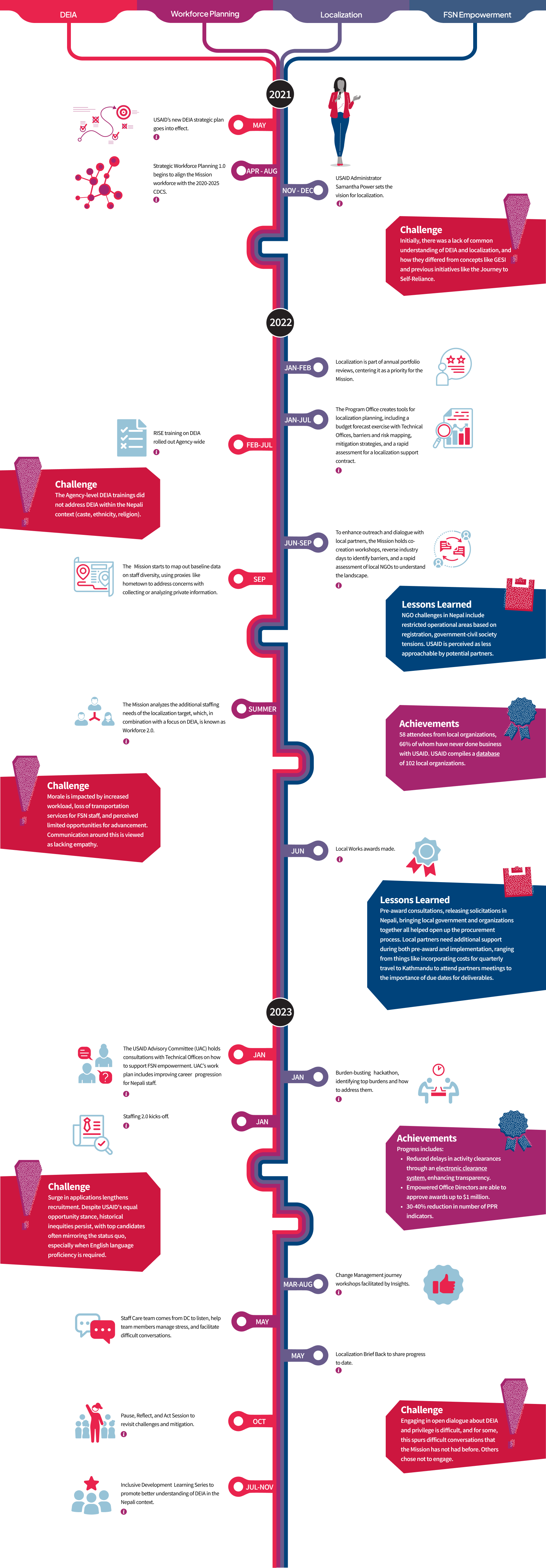
In November 2021, USAID Administrator Samantha Power laid out a transformative vision for inclusive sustainable development that would allocate more resources to local actors and organizations and integrate local voices into all parts of USAID programming. Localization involved not only financial allocations but also a shift in power, decision-making authority, and leadership to the local level across all program phases. At the same time, the Agency was also beginning implementation of the DEIA Strategic Plan, establishing the Office of the Chief DEIA Officer and making other strategic shifts to move the Agency towards a DEIA vision. This site documents how USAID/Nepal has worked towards these two, interlinked goals, including achievements, challenges, and lessons learned along the way.
This webpage documents the evolution of change management processes within USAID/Nepal, particularly in response to the Agency’s strategic shifts towards emphasis on Diversity, Equity, Inclusion, and Accessibility (DEIA) and localization. The primary aim of this webpage is threefold:

To provide a comprehensive account of the changes implemented by USAID/Nepal.

To take stock of Mission staff members’ reflections and emotional experiences throughout this transformative process.

To disseminate the insights from USAID/Nepal change initiatives across the broader Agency.

USAID Learning For Development conducted a series of consultations from August to October 2023 across USAID/Nepal for this documentation. The data collection approach was sequential and iterative:

Desk Review: A review of relevant documentation related to localization and DEIA initiatives, including strategies, notes and slides from internal meetings and workshops, and data on funding and staffing.
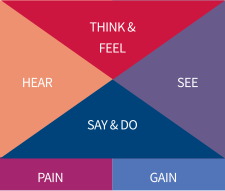
Empathy Mapping: To gain deeper insights into the emotional landscape of the Mission staff during periods of change, we conducted an empathy mapping exercise across all 10 USAID/Nepal offices, engaging 88 staff members. This exercise explored staff members’ initial thoughts and feelings upon the introduction of localization and DEIA, their observations during ensuing changes, and their current perspectives and actions. Each session began with a video from the Mission Director to help set the session’s intention.

Focus Group Discussions: Building upon the insights garnered from the empathy mapping sessions, we conducted 5 FGDs with 41 staff members to explore staff reactions, experiences, and suggestions in depth.

Direct Observation: USAID Learning for Development attended relevant events and meetings occurring during the documentation process such as Insights Workshops, the 2023 Inclusive Development Learning Summit, and portfolio reviews to directly document these parts of the change process.

Key Informant Interviews: We conducted 15 purposely selected key informant interviews with past and present USAID/Nepal staff members who were closely involved in the design and execution of change initiatives including staffing, FSN empowerment, budgeting, DEIA initiatives, and localization.

Stakeholder Consultations and Survey: We conducted seven in-person interviews with government counterparts from the following ministries:
-
Ministry of Finance
-
Ministry of Federal Affairs and General Administration
-
Ministry of Health and Population
-
Ministry of Education, Science, and Technology
-
Ministry of Energy, Water Resources, and Irrigation
-
National Statistics Office
Change is not just about process and outcomes–change is about people, and change management processes thrive and fail based on how the people involved are engaged. On this page, we present the findings from ten Empathy Mapping sessions, which took stock of how staff members felt at different phases (Starting Point, Mid-way, Now) of the change management process.
People experienced different emotions at different stages, and generally followed a curve similar to most change management processes, with more positive emotions early and late with more negative emotions in the middle.
Image Credit: Kubler-Ross Framework for Stages of Grief
Think & Feel
(Starting Point)
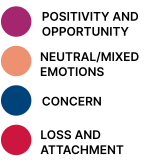
Positivity and Opportunity
Out of 90 responses, 39% expressed positivity.
The respondents navigating change within the Mission were genuinely hopeful and eager for what lay ahead. They saw this as an opportunity for learning and growth, and were excited about working more closely with government and local organizations. The general perception of localization and inclusive development was seen as an opportunity to bring sustainable solutions and a more inclusive culture. While there was eagerness, respondents also recognized the need for hard work and ongoing evaluations to make sure things progress well. Overall, there was a shared sense of unity and readiness to embrace the changes with optimism and enthusiasm.
Neutral/Mixed Emotions
20% of the responses were neutral
From these responses, there was a sense of both hopefulness and wariness, with individuals acknowledging the importance of adaptation while also expressing doubts about the feasibility and long-term impact of the changes. Additionally, there was confusion surrounding the novelty or the initiatives and how they differ from past efforts.
Concern
23% voiced their concerns
These responses reflected skepticism about the longevity of initiatives, especially from many who have worked for USAID for a long time, and worry about how to practically achieve goals given USAID rules and regulations. There was a sense of uncertainty on how staff members would build additional skills for a new style of working with different stakeholders. Confusion surrounded the complexity of DEIA implementation and its perceived benefits, especially regarding staff empowerment and local capacity building. Overall, there was a palpable sense of uncertainty and confusion, emphasizing the need for clearer guidance, practical solutions, and effective communication strategies.
Loss and Attachment
18% of the responses were that of loss and attachment
The responses showed a sense of frustration with re-introducing what some perceived as the same concept as the Journey to Self-Reliance and other past initiatives. Many felt overwhelmed and skeptical about the efficacy of diversity, equity, inclusion, and accessibility (DEIA) initiatives, and didn’t clearly see how this differed from GESI. Respondents also questioned the Agency’s commitment and saw the ambitious localization funding goal as top-down and impractical. Overall, there was a prevailing sense of skepticism, stress, and disillusionment surrounding the change management process.
See & Hear
(Midpoint)
Positivity and Opportunity
27% of responses reflected positivity and opportunity
There was recognition of increased engagement with local stakeholders, including co-creation events and more government-to-government activities. This group perceived management as supportive, and were appreciative of initiatives like Workforce 2.0 and DEIA receiving attention. There was a sense of hopefulness and enthusiasm among many, with staff members appreciating the opportunity to engage in discussions and learning initiatives to help prepare for the new way of working.
Concern
26% were concerned
While respondents were eager for change, barriers and challenges were apparent. Confusion and anxiety arose regarding the practical implementation of initiatives like working directly with government and DEIA. Concerns also centered around the feasibility of new ideas and meeting USAID standards and bureaucratic complexities. Moreover, uncertainty loomed over the long-term sustainability of efforts like DEIA and localization. Disparity in understanding key concepts (specifically DEIA) further compounded confusion.
Neutral/Mixed Emotions
10% were neutral or mixed
There was excitement and anticipation surrounding the localization initiatives, with the Mission showing genuine enthusiasm. This was combined with a sense of uncertainty and apprehension among some, particularly regarding the clarity of objectives and the surprises encountered during implementation. Despite these mixed emotions, there was acknowledgement of the seriousness with which the Front Office was approaching change.
Loss and Attachment
37% felt loss and attachment
There was a prevailing sense of discontent with the current state of affairs, characterized by a lack of clarity, mistrust, and perceived sidelining of current staff, such as prioritizing external candidates for new leadership positions. Further concerns about the implementation of DEIA initiatives, staffing changes, and the overall direction of the Mission are prominent, with many feeling unheard and excluded from decision-making processes. Additionally, many voiced fear of repercussions for voicing dissent or questioning the status quo. Overall, the prevailing atmosphere was one of discomfort and uncertainty, with individuals grappling with various challenges and anxieties as the change process unfolds.
Say & Do
(Now) *As of data collection from September 2023 – November 2023
Positivity and Opportunity
53% reflect positivity and opportunity.
As the change management process progressed, there was a growing sense of optimism and readiness among individuals. They recognized the importance of initiatives like DEIA and localization, actively participating in training and discussions to understand and apply these concepts. Despite challenges and uncertainties, there was a collective commitment to adapt, learn, and work together towards meaningful progress.
Concern
13% were concerned
While some were starting to grasp the Mission’s objectives and adapt to new practices, others remained confused and overwhelmed by the challenges. Concerns lingered about the long-term sustainability of the changes, especially with the potential for shifts in administration priorities. Additionally, there was a recognition of the need for ongoing learning and documentation of lessons learned, as well as building the evidence base for localization, to ensure effective implementation.
Neutral/Mixed Emotions
13% were neutral
Individuals expressed a sense of cautious optimism. They emphasized the importance of understanding each other’s perspectives and adapting to change slowly and carefully. While acknowledging positive policy leadership and efforts to incorporate DEIA, there were also concerns about the effectiveness of these efforts, particularly in addressing education requirements in hiring processes etc.
Loss and Attachment
22% expressed loss and attachment.
Some staff members felt unprepared for government-to-government engagements, while others perceived USAID rules and regulations as incompatible with the mission of localization. There were criticisms regarding the organization of inclusive learning sessions and a gradual decrease in willingness to engage in difficult conversations due to perceived challenges and lack of receptiveness. Some individuals felt unheard or marginalized, leading to a sense of disillusionment and exhaustion. People expressed desire for clearer communication, team collaboration, and more support from leadership.
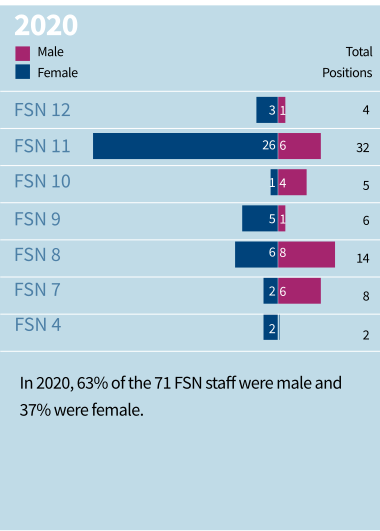
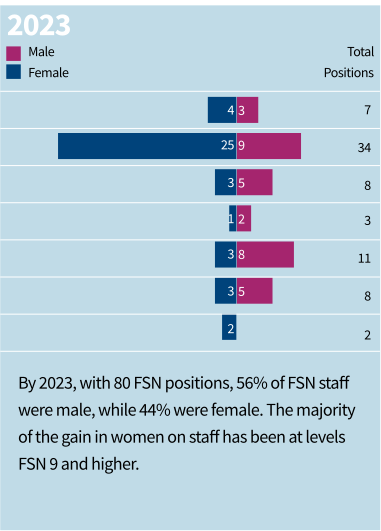
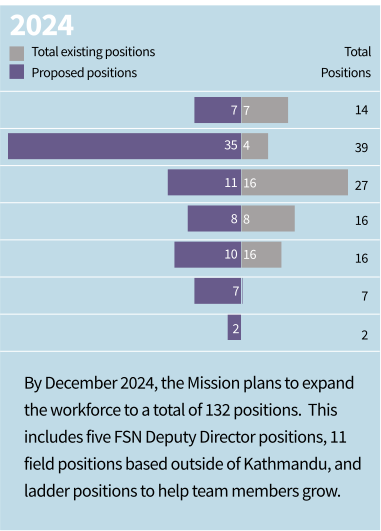
Part of USAID/Nepal’s focus on localization and FSN empowerment has entailed targeting a more diverse staff composition.
USAID/Nepal Locally Employed Staff Composition
Staff Home Districts

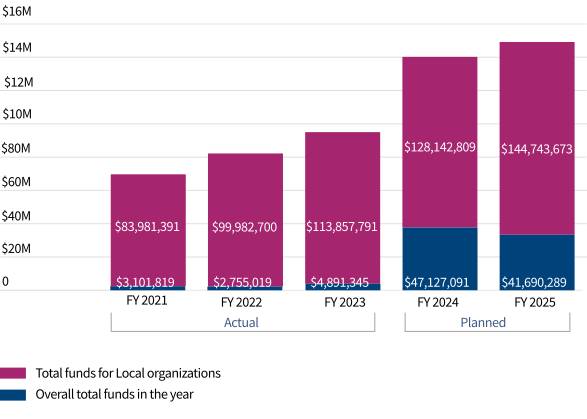
Localization and G2G Funding
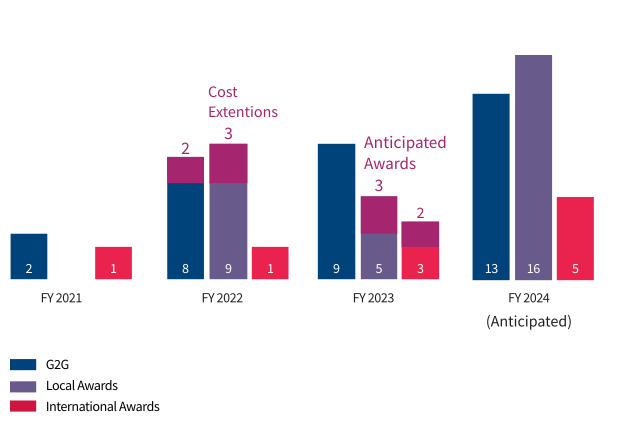
New and Anticipated Awards
The feedback from USAID/Nepal on the change management process demonstrated two overarching themes:
the tension between change and USAID's regulations and processes, and the importance of clear,
empathetic communication.
The balancing act between USAID rules and regulations, which can be inflexible; the vision for rapid change, which requires a new way of working and thinking; and people, who are sometimes caught in the middle.
Effective communication–including empathy, transparency, consistency, timeliness, fostering safe spaces, navigating difficult conversations, and ensuring closure–was a core value across all groups. While the Mission has made some efforts to promote communication through All Hands Meetings and Insights sessions to build self-awareness around different communications styles, people still observed gaps: times where they felt they did not know what was going on, difficulty giving honest feedback, and not feeling heard.